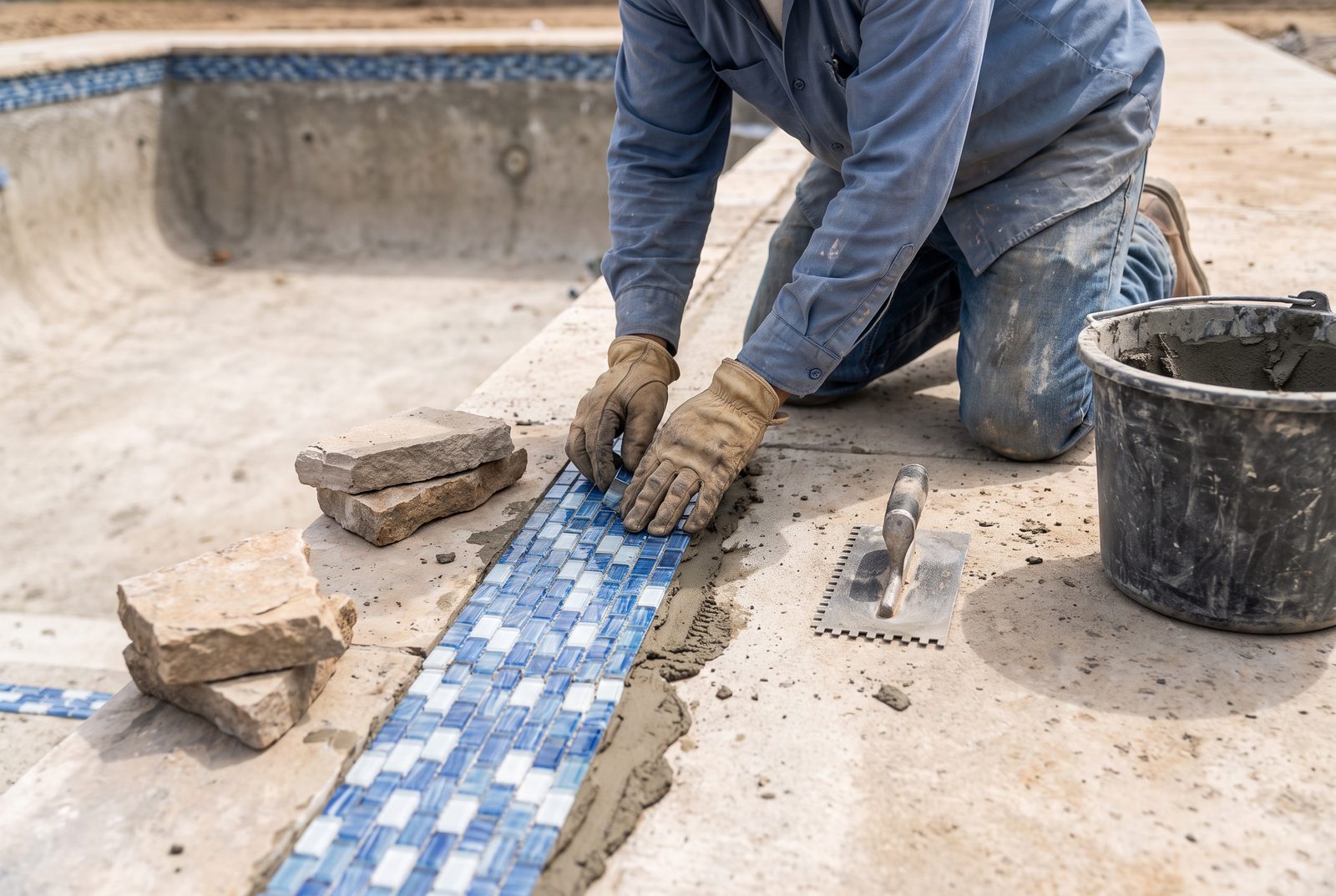
Rough plaster, a chalky waterline ring, and stains that keep coming back are all the same message — the interior finish is done. Here's what replacing it actually involves.
Pool resurfacing in McAllen means stripping off the worn interior finish of your pool and putting a new one on: plaster, quartz, or pebble, troweled over the concrete shell underneath. It is not a cosmetic touch-up. The finish is the waterproof layer between your water and the structure, and once it starts flaking, etching, or shedding aggregate, it stops doing that job.
Most homeowners here call about it for one of three reasons: the floor got rough enough to scrape feet and swimsuits, a white crust built up along the tile line and won't scrub off, or a patch of staining survived an acid wash. All three are surface problems with the same fix, and none of them get cheaper by waiting.
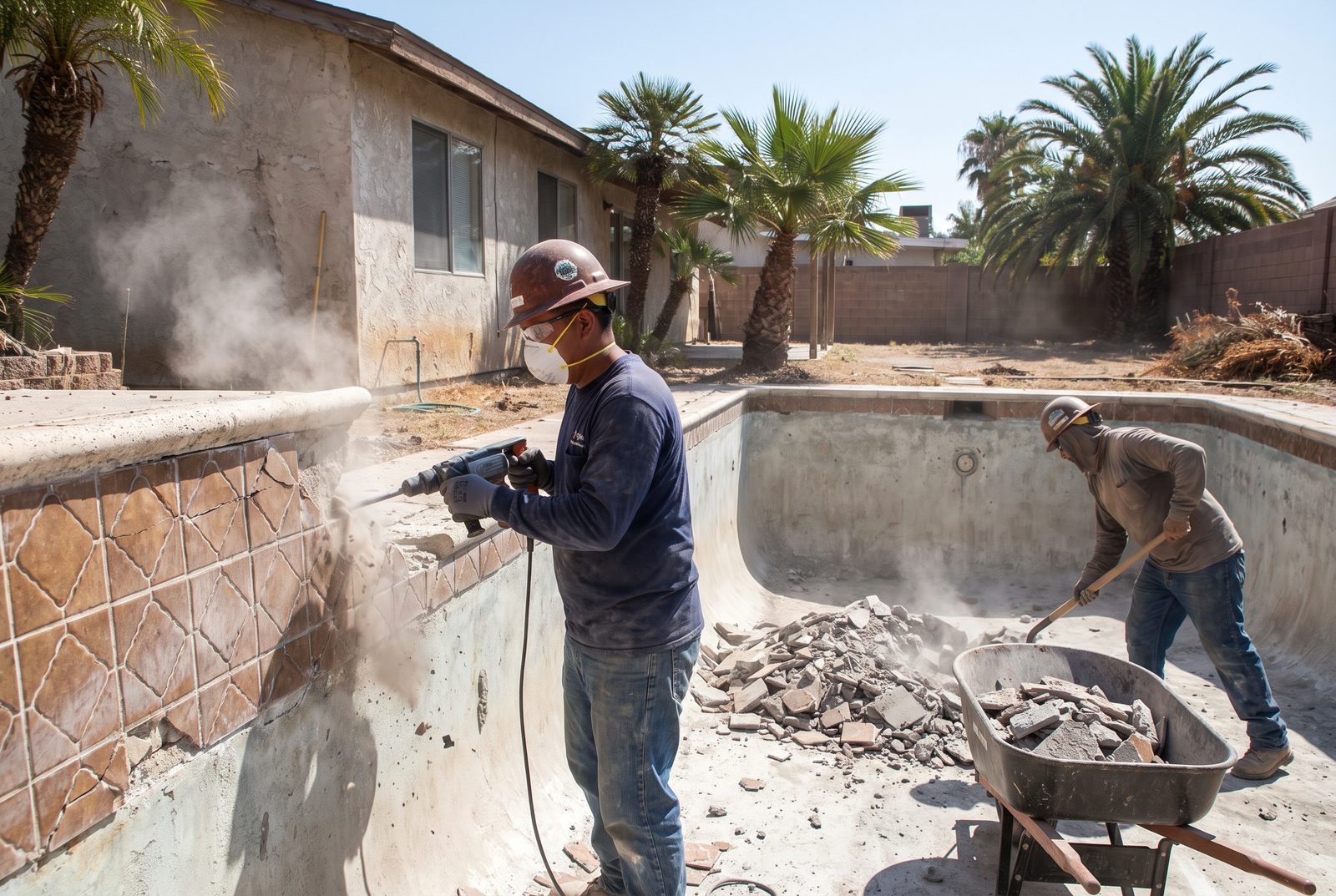
The pool gets drained first, which is the only time anyone gets an honest look at the shell. Then the old finish comes off — chipped back to sound concrete where it has delaminated, sanded and prepped where it is still bonded. Hollow spots and hairline cracks get cut out and patched at this stage rather than covered up.
Next comes a bond coat so the new material has something to grip. The American Shotcrete Association's guidance for pool work is to pressure wash the substrate before any plaster or tile goes on, and skipping that step is a common reason a finish delaminates a few years early. The new finish is then applied and hand-troweled in a single continuous session, since you cannot stop halfway through a pool and start again the next morning without leaving a seam.
Pebble and exposed-aggregate finishes get washed or acid-exposed to reveal the stone. From there the pool is refilled immediately — a fresh finish should not sit dry — and goes into a startup period of daily brushing and tight chemistry control for the first month while the surface cures.
Water chemistry, mostly — and McAllen starts with a harder deck of cards than most of the country. Municipal water here runs around 14.5 grains per gallon, roughly 248 parts per million, which lands squarely in the "very hard" range and is about double the U.S. average of 7.3 grains per gallon.
That mineral load cuts both ways. When water sits saturated with calcium, it drops the excess out as scale, which is the chalky ring that forms at the tile line and refuses to scrub off. When the same water swings the other direction — calcium hardness drifts low, or pH sits under 7.2 for a stretch — it becomes hungry and pulls calcium back out of the plaster instead. That is etching, and it is what turns a smooth floor into sandpaper.
South Texas weather keeps that pendulum swinging. August highs here average close to 100°F, evaporation runs a quarter to a half inch off the surface most days, and the yearly rainfall total is only about 22 inches. So the pool is constantly being topped off with more hard tap water, and every refill adds calcium the pool then has to balance. A finish that might see 15 years in a soft-water city can show its age here noticeably sooner.
Resurfacing is priced by interior surface area, not by the footprint of your yard, and that trips people up. A 15-by-30 pool has 450 square feet of floor, but add roughly 90 feet of perimeter wall at an average depth around five and a half feet and you are closer to 1,000 square feet of surface to cover.
The traditional finish and the least expensive per square foot. Bright, classic turquoise water and the shortest service life of the three.
$6 – $8 / sq ftPlaster with quartz aggregate blended in. Harder surface, better stain and etch resistance, wider color range.
$7 – $10 / sq ftSmall river stone in a cement matrix. The most durable option against hard water, and the most textured underfoot.
$7 – $15 / sq ftOn a typical 1,000-square-foot residential pool, that works out to roughly $6,000 to $8,000 in white plaster, $7,000 to $10,000 in quartz, and $7,000 to $15,000 in pebble depending on the stone. Those are finish-only numbers.
What moves them: replacing waterline tile or coping at the same time (worth doing, since the pool is already drained), how much of the old finish has delaminated and needs full chip-out versus a bond coat, structural cracks discovered once the water is out, and the cost of the 15,000 to 25,000 gallons it takes to refill. If your pool also needs new decking or a reshaped layout, that is a full pool remodel in McAllen rather than a resurfacing job, and it gets quoted differently.
The honest way to compare these is cost per year of service, not sticker price. White plaster at $7,000 over a nine-year life runs about $780 a year. Pebble at $11,000 over an eighteen-year life runs about $610 a year, and you replace it half as often — which also means half as many summers with the pool drained.
White plaster still makes sense if you are planning to sell within a few years, or if the budget needs to stay tight right now. It gives you the brightest, most familiar blue water of the three.
Quartz is the middle road most McAllen homeowners land on. The quartz aggregate is harder than plain cement, so it resists both the etching and the staining that our water encourages, and it comes in enough colors to change the look of the pool without committing to dark pebble.
Pebble is the choice if you intend to keep the house. It handles hard water better than anything else in this list and hides the early stages of scale far more gracefully. The trade-off is texture: some people love how a pebble floor feels, and some find it rough on bare feet, so ask to hold a sample before deciding. Polished pebble finishes soften that texture at a higher price.
White plaster generally lasts 7 to 12 years, quartz finishes 10 to 15, and pebble finishes 15 to 20 or more. McAllen's very hard tap water tends to push pools toward the shorter end of those ranges, because every top-off during a hot summer adds more calcium to the water. The finish itself will tell you before the calendar does: when the floor turns rough underfoot and acid washing stops helping, it's time.
No. The old finish has to be chipped or sanded back and the shell has to be dry for the bond coat to grab, so the pool gets drained first. Draining is also the only time anyone gets a clear look at the shell, which is when hairline cracks and hollow spots usually turn up. In McAllen we keep the empty window short, because a drained pool sitting in Rio Grande Valley groundwater can float if it's left open too long.
Most McAllen resurfacing jobs run about five to seven days from drain to refill: one to two days of chip-out and prep, a day for the new finish to go on, and an acid wash or exposure step depending on the material. Filling a residential pool takes another 12 to 24 hours on a garden hose. Add time if waterline tile or coping is being replaced at the same time.
That sandpaper texture is etching. When pool water runs low on calcium hardness or sits at a low pH, it pulls calcium back out of the plaster and leaves the sand and cement behind as a gritty surface. It is the opposite problem from the white scale ring at the waterline, and both are common in McAllen because the water here starts out very hard and swings as it evaporates and gets topped off.
Only if the water is escaping through the finish itself, which is the less common case. Most leaks in McAllen pools are at the skimmer throat, a return fitting, or in the underground plumbing, and a fresh coat of plaster will not touch any of those. Have the leak located first, then resurface, so you are not sealing a new finish over a problem that is still there.
Yes, and resurfacing is the only practical time to do it. The finish material is what gives the water its color, so a white plaster reads bright turquoise, a mid-gray quartz reads deeper blue, and a dark pebble reads almost black-green. We bring physical samples to the estimate, because these finishes look very different wet, dry, and under full South Texas sun.