Repair & Leak Detection

Pool Leak Detection in McAllen, TX

Before you pay anyone to find a leak, find out whether you actually have one — South Texas evaporation alone can pull half an inch a day off your pool.

Pool leak detection in McAllen is the process of proving where water is escaping — the shell, a fitting, the skimmer, or the underground plumbing — before anyone breaks concrete looking for it. It is a diagnostic job first and a repair job second, and the two get priced separately for good reason.

Here is the part most companies skip: in a climate like ours, a large share of "my pool is leaking" calls turn out to be normal evaporation. We would rather spend ten minutes on the phone walking you through a test you can run yourself than send a truck to confirm your pool is fine. If it turns out you do have a leak, then it is worth finding properly.

The Process

What Does Pool Leak Detection Involve?

It works by elimination, cheapest test first. The starting question is whether the pool loses water with the pump running, with it off, or equally either way. A pool that drops faster while the equipment runs points at the return side, since those lines are under pressure. One that drops faster with the pump off points at the suction side or the shell.

From there the plumbing gets isolated. Individual lines are plugged and pressure-tested one at a time, and a line that will not hold pressure has been found without digging anything up. Listening equipment then traces the sound of escaping water along the buried run to pin the break to a spot rather than a general area, which is the difference between opening two feet of deck and opening twenty.

Inside the pool, dye testing does the fine work. A small amount of dye released next to a suspect skimmer throat, light niche, return fitting, or crack will get pulled in visibly if that is where water is going. Skimmers get checked closely because the plastic skimmer body and the concrete shell around it expand at different rates, and that seam is the most common leak point on an inground pool.
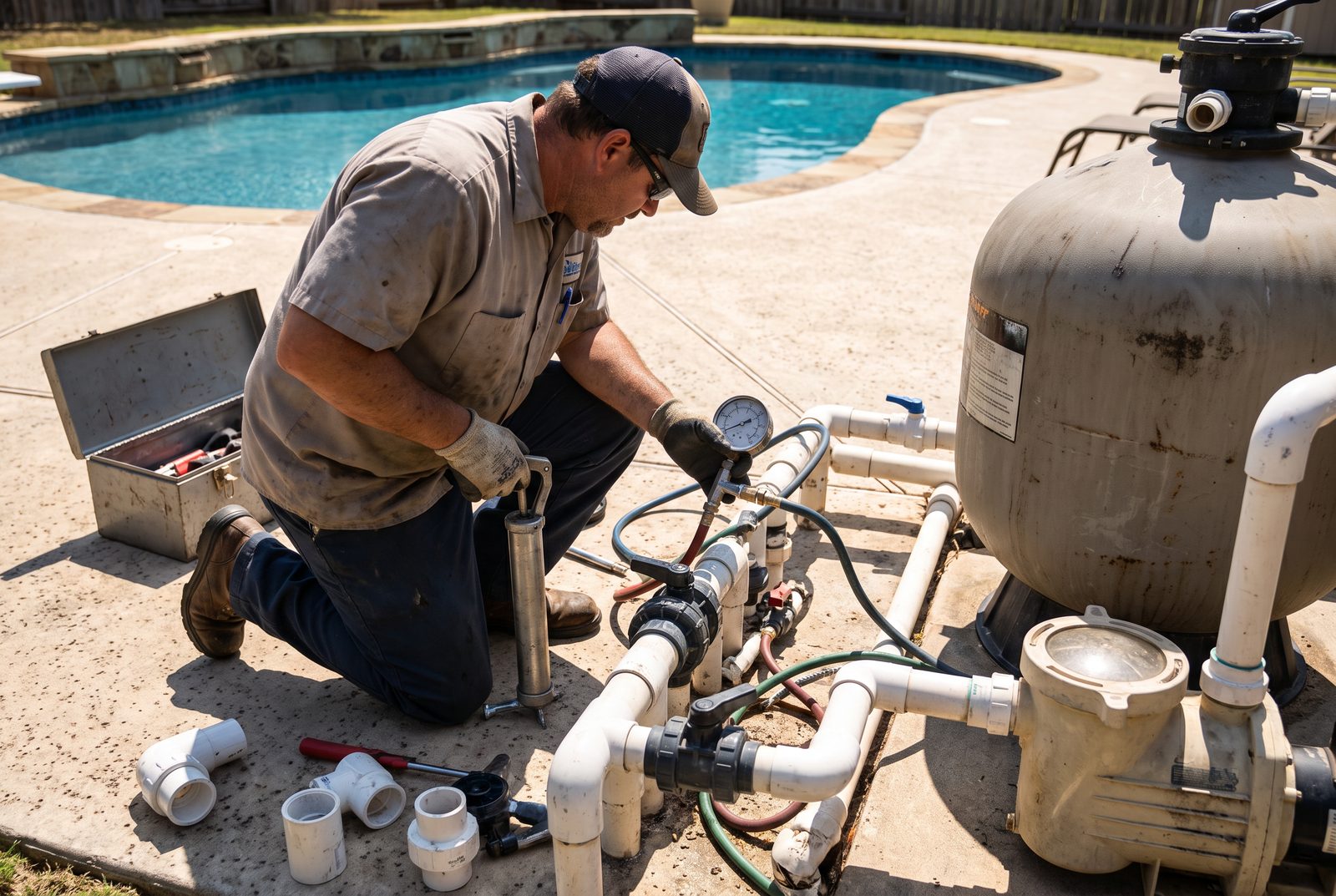
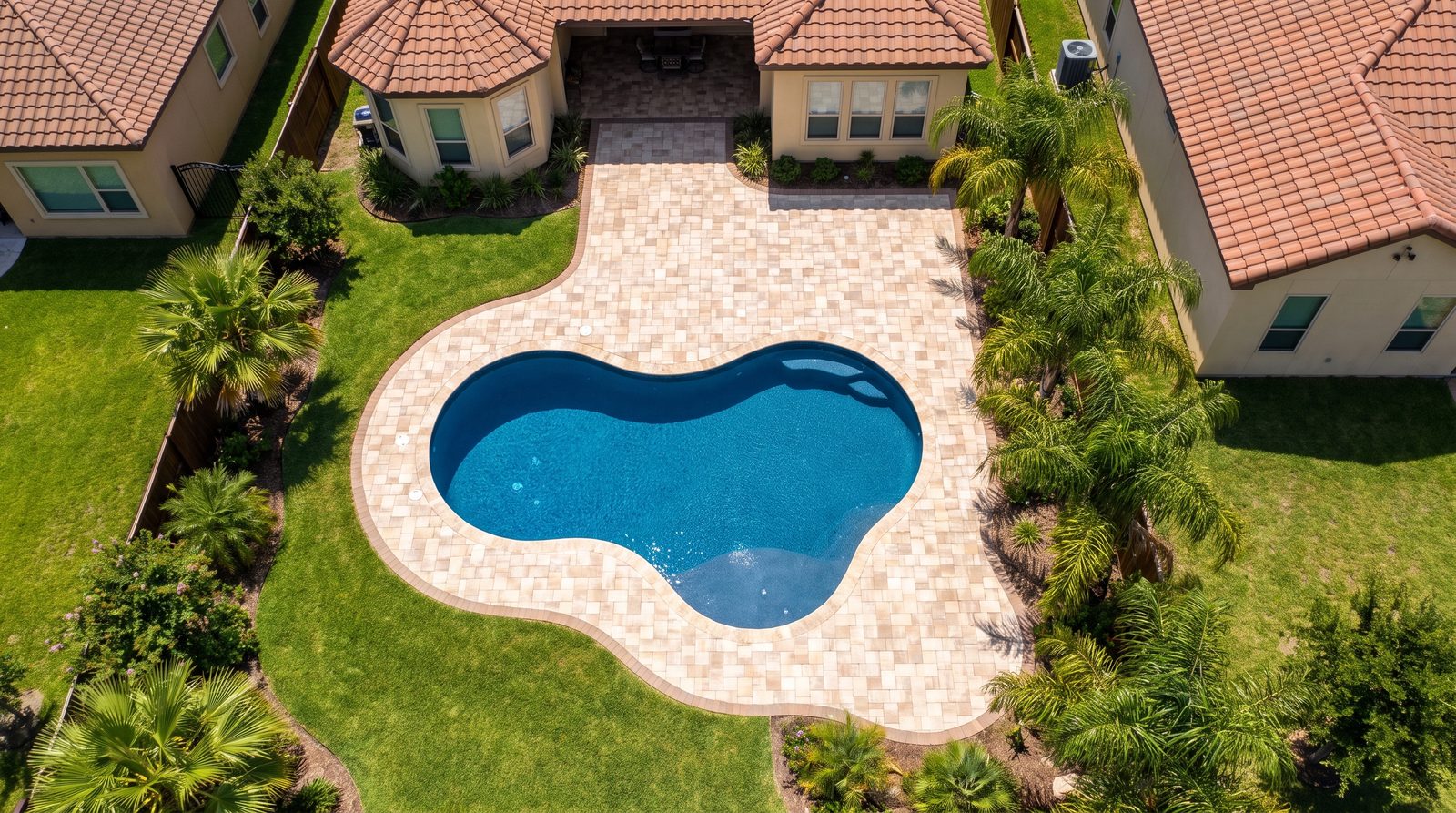
Pool leak detection in McAllen on a drained pool shell
Signs It's Time

When Do You Need Pool Leak Detection?

Pool repair in McAllen at the waterline and pool edge
The Real Cause

Why Do Pools Leak in the Rio Grande Valley?

Movement, mostly. Many Valley lots sit over caliche, a hardpan layer cemented together by calcium carbonate that acts as a barrier to water draining downward. Runoff that would normally soak away instead collects in the soil above it, so the ground around a pool goes through pronounced wet and dry swings, and the shell, deck, and buried plumbing all move slightly against each other every time it does.

Those movements are small, but the connections are not forgiving. A rigid PVC line glued to a fitting has no tolerance for the soil shifting an eighth of an inch, and a skimmer cast into concrete has none for a slab that settles. Heat compounds it: with June through August highs averaging 97°F to 100°F here, materials sitting in full sun cycle through significant expansion every single day.

The last factor is water chemistry. McAllen's tap water is very hard — about 14.5 grains per gallon, roughly 248 parts per million — and a pool that is being topped off constantly because of a leak accumulates minerals faster than one that is not. The leak makes the scale worse, and the scale hides the leak. Finding it early breaks that loop.

Do This First

Evaporation or a Real Leak: How to Tell Before You Call

An uncovered inground pool in this climate loses roughly a quarter inch to a half inch a day to evaporation on its own, which adds up to about one and a half to three and a half inches a week. That is normal. More than two inches a week deserves a look, and close to an inch a day is almost certainly a leak.

The bucket test settles it, and it costs nothing. Turn off the autofill. Fill a five-gallon bucket with pool water to about an inch below the rim and set it on the first or second step so it is submerged roughly five inches. Mark the water level inside the bucket and the pool level outside it, then walk away for 24 hours with the pump running on its usual schedule.

Both surfaces are exposed to the same sun, wind, and humidity, so both should evaporate at the same rate. If the pool level dropped further than the bucket level, that difference is your leak. If the two dropped together, you are watching McAllen weather do its job and nothing is wrong. Rain during the test invalidates it, so wait for a clear 24 hours.

For scale on what that difference is worth: on a 15-by-30 foot pool, a single inch of depth is about 280 gallons. Losing an extra inch a day is roughly 8,400 gallons a month.

Investment

What Does Pool Leak Detection and Repair Cost in McAllen?

Detection and repair are two separate line items, and any company that quotes a single flat number before seeing the pool is guessing. Locating a leak on an inground pool generally runs $400 to $1,000. What the repair costs after that depends entirely on what the diagnosis turns up.

Skimmer or Fitting

The most common find and the least expensive fix. Reseal or replace the component and the seam around it.

$50 – $300

Shell Patch

Cutting out and properly patching a crack or hollow spot in the concrete shell, done professionally.

$150 – $500

Main Drain Line

The expensive one, because reaching it means going through the pool floor or rerouting the run entirely.

$700 – $2,500

Two things move a repair bill more than anything else. The first is access — a line running under a plain dirt side yard is straightforward, while the same line under a travertine deck means lifting and resetting stone. The second is how long the leak ran. Water escaping under a slab washes out the base material it sits on, so a leak caught in a month is a plumbing repair, and the same leak caught in a year can also be a pool deck repair in McAllen.

Before You Hire Anyone

How to Vet a Pool Repair Company in Texas

Worth knowing: Texas does not issue a state license specifically for building or repairing residential swimming pools. Plenty of companies advertise as "licensed" and mean a general business registration, which is not the same thing and is not a credential you can look up.

What is real and verifiable: any electrical work on a pool has to be done by a Texas-licensed electrician and must meet the bonding and grounding rules in Article 680 of the National Electrical Code, and plumbing work falls under the Texas State Board of Plumbing Examiners. Ask which licensed trades are doing those portions and get the license numbers.

Then ask for a current general liability certificate naming the company, and confirm the work will be permitted. McAllen has adopted the 2024 edition of the International Swimming Pool and Spa Code, so structural and equipment work goes through the city rather than around it. A contractor who is casual about permits is telling you something about the rest of the job.

Losing Water and Not Sure Why?

Run the bucket test, then call us with the number. We'll tell you honestly whether it's worth a service visit.

Questions

Frequently Asked Questions

How much water loss is normal for a pool in McAllen?

An uncovered inground pool normally loses about a quarter inch to a half inch a day to evaporation, which works out to roughly 1.5 to 3.5 inches over a week. In McAllen's summer heat the upper end of that range is common and not a problem. Losing more than two inches in a week is worth investigating, and anything approaching a full inch a day is almost certainly a leak rather than evaporation.

How do I do the bucket test on my pool?

Turn off any autofill device, then fill a five-gallon bucket with pool water to about an inch below the rim and set it on the first or second step so it sits roughly five inches deep. Mark the water level inside the bucket and the pool level outside it, then leave everything alone for 24 hours with the pump running as usual. If the pool level dropped further than the bucket level, the difference is a leak, because both surfaces evaporated under identical conditions. Rain during the test ruins it, so start over on a clear forecast.

How much does pool leak detection cost?

Professional leak detection on an inground pool generally runs $400 to $1,000, which covers locating the leak rather than fixing it. Repair is priced separately and varies enormously by what is found: a skimmer or fitting repair often lands between $50 and $300, a professional patch runs about $150 to $500, and a failed main drain line can reach $700 to $2,500 because it means getting under the pool floor.

Where do pool leaks usually happen?

On inground pools the usual suspects are the skimmer throat, return and light fittings, the underground plumbing runs, the main drain, and cracks in the shell itself. Skimmers are the single most common because the plastic skimmer body and the concrete shell expand at different rates, and the seam between them eventually separates. That is also one of the cheaper repairs, which is why it pays to look there first.

Does a leaking pool waste much water?

More than most people expect. On a 15-by-30 foot pool, one inch of depth is about 280 gallons, so a leak dropping the level an inch a day beyond normal evaporation is roughly 8,400 gallons a month going into the ground. In McAllen that also means constantly refilling with very hard tap water at about 14.5 grains per gallon, which drives up scale and chemical costs alongside the water bill.

Should I fix a leak before resurfacing my pool?

Yes, and in that order. Most leaks are in plumbing and fittings rather than in the finish, so a new coat of plaster will not stop them, and you would be covering a live problem with a finish you just paid for. Locating and repairing first also means any shell cracks get properly cut out and patched while the pool is drained, which is the right time to resurface anyway.