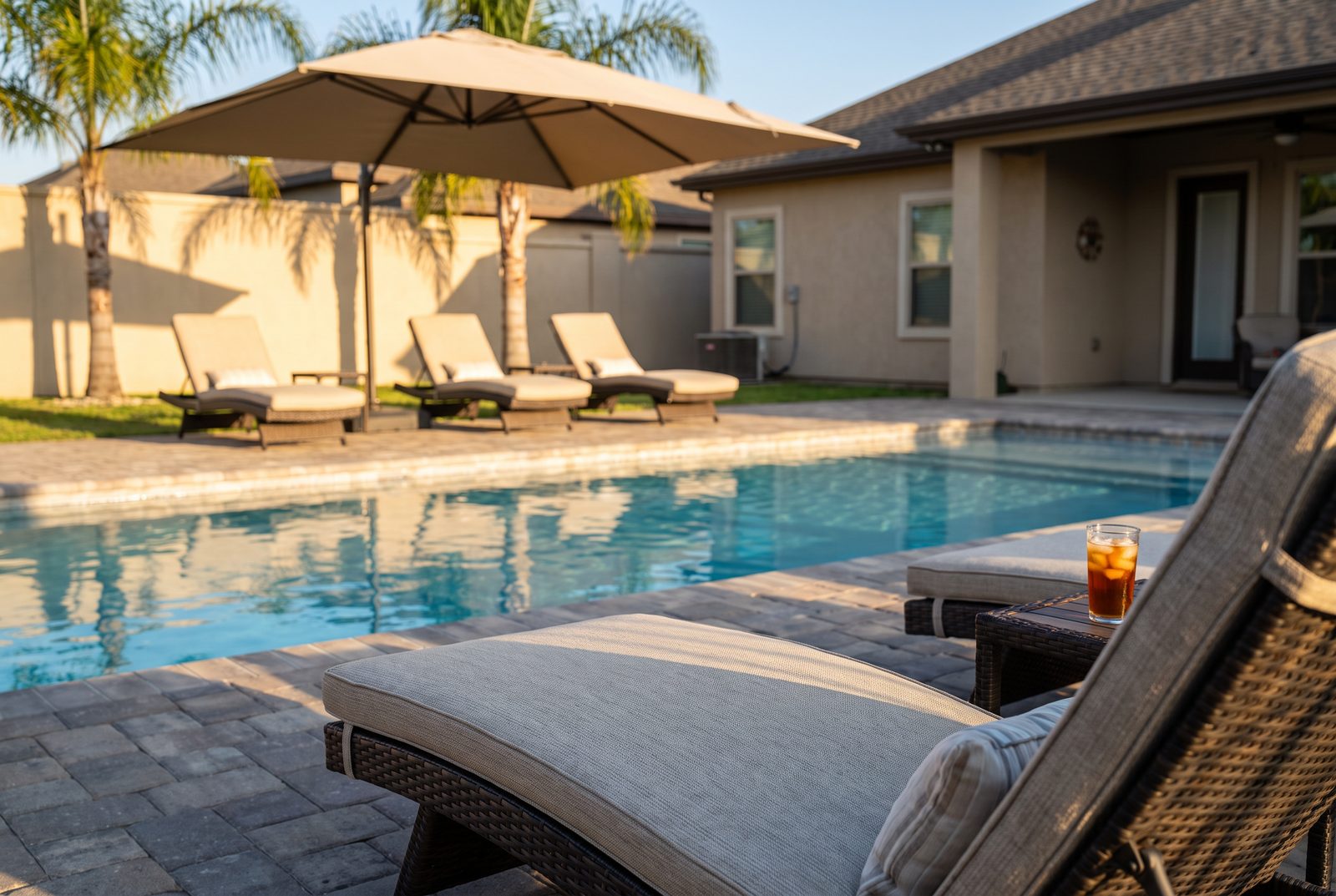
In a city where August highs sit within a degree of 100°F, the surface around your pool decides whether the backyard gets used at 3 p.m. or only after sundown.
Pool decking in McAllen covers everything from the coping at the pool's edge out to wherever your patio ends: the slab or pavers, the base underneath, the drainage that moves water away from the house, and the expansion joints that let all of it move without tearing itself apart. It is the part of a pool project people think about least and touch the most.
It is also the one component where South Texas changes the answer. A material that works fine in a mild climate can become genuinely unusable here for four months of the year, and homeowners often discover that only after the concrete is already poured.
It starts with grade and drainage, not with material. We shoot elevations to confirm the deck will shed water away from both the pool and the house, because a deck that drains backward pushes runoff toward your foundation and returns dirt and debris into the pool every time it rains.
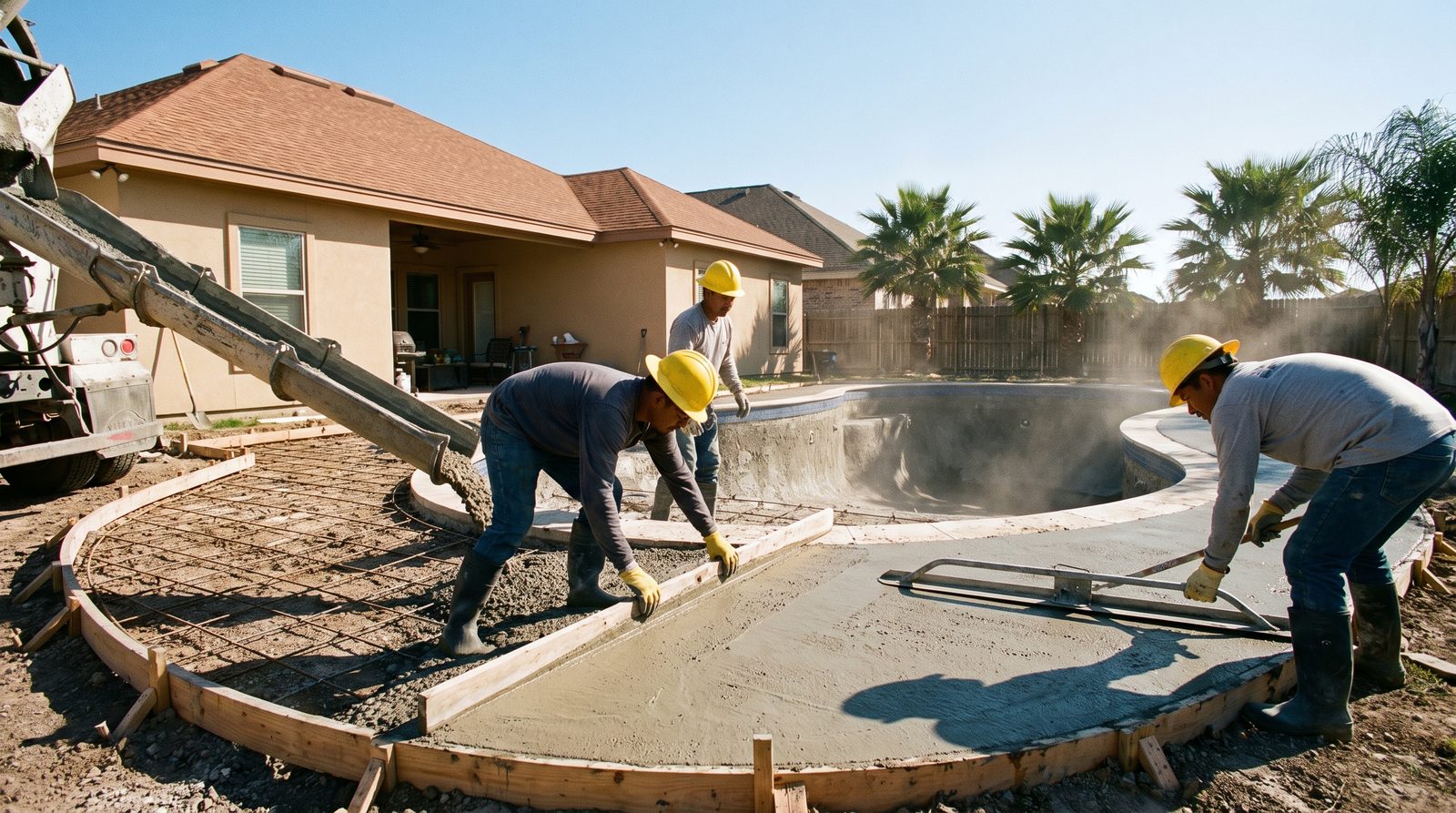
Old decking gets demolished and hauled out if we are replacing rather than overlaying. Then the base goes in: compacted fill graded to the slope we just established, which is the layer that determines whether the finished surface stays flat in five years. For poured concrete, forms and reinforcement come next, then the pour, the finish texture, and control joints cut at spacings that give the slab a planned place to crack instead of a random one.
Pavers and travertine take a different path — a screeded bedding layer, each unit set and leveled by hand, then edge restraints and joint sand. Slower to install, but any single piece can be lifted and reset years later without a saw and a jackhammer.
Because dark, dense surfaces absorb solar energy and hold it. Measured side by side in direct summer sun, dark concrete pool decks have been recorded above 140°F while light travertine on the same site sat between 95 and 110°F — a spread of roughly 20 to 40 degrees between two decks in identical conditions.
That is not a comfort footnote. Skin contact with a surface over 140°F can cause burns within seconds, which is why kids sprint across a hot deck and why a dog will refuse to. In McAllen the exposure window is long: June, July, and August all average highs between 97°F and 100°F, and the record here is 111°F set in June 2017.
Two things drive the number. Color comes first — a pale surface reflects instead of storing, and this matters more than which material you picked. Porosity comes second: pavers and travertine have air gaps and open joints that let heat bleed off, while a solid troweled slab acts like a battery. A dark stamped concrete deck manages to get both of those wrong at once, which is why it is the most common regret we hear about in Valley backyards.
Deck pricing is straightforward square footage math once you pick a material. Most residential pool decks fall in the 400 to 600 square foot range, so 500 square feet is a fair number to plan against.
The budget baseline. The brushed texture gives usable grip, and a light color keeps the surface temperature reasonable.
$6 – $15 / sq ftPatterned to imitate stone. Looks the part, but choose a light release color here or it will bake in July.
$14 – $28 / sq ftIndividually set units with open joints that drain and vent heat. Any single paver can be lifted and replaced later.
$20 – $35 / sq ftNatural stone, naturally pale and porous. The coolest surface underfoot of anything on this list.
$22 – $38 / sq ftA textured acrylic coat over sound existing concrete. Roughly 8 to 12 years of service before it needs redoing.
$4 – $8 / sq ftDemolition and haul-off of the old slab, drainage correction, new coping, retaining or step work, and access for equipment.
Quoted per jobAt 500 square feet, that puts a plain concrete deck in the $3,000 to $7,500 window and a travertine deck around $11,000 to $19,000. Tearing out an existing deck first typically adds a few dollars per square foot, and fixing drainage that was wrong from the start adds more — but skipping that is how the next deck ends up cracking too.
Resurfacing makes sense when the slab is structurally fine and the complaints are about heat, slickness, or looks. A cool-deck overlay at $4 to $8 per square foot solves all three for a fraction of a teardown, and on a 500-square-foot deck that is a $2,000 to $4,000 decision instead of a $15,000 one.
Replacement is the call when the concrete itself has failed. An overlay is only as flat as what is under it, so a slab that has settled at a joint, heaved, or cracked through will telegraph every one of those problems through a fresh coating within a season or two. Same answer if the deck drains the wrong direction — grade is fixed in the base, not in the topping.
The gray-area case is a sound slab that you have already overlaid once or twice. Each coating adds thickness at the pool edge and against door thresholds, and at some point tearing out and starting clean costs less than continuing to build up. We will tell you which side of that line your deck is on during the estimate rather than after the deposit.
Light-colored travertine is the coolest common option. Testing in comparable Sun Belt conditions puts white travertine in the 95 to 110 degree range while dark concrete alongside it passes 140 degrees, a gap of roughly 20 to 40 degrees. Light concrete pavers finish close behind travertine. The single biggest factor is color, not material, so a pale surface in any of these will beat a dark one in McAllen sun.
Installed costs generally run $6 to $15 per square foot for broom-finished concrete, $14 to $28 for stamped concrete, $20 to $35 for concrete pavers, and $22 to $38 for travertine. A typical 500-square-foot pool deck therefore lands somewhere between about $3,000 on the plain-concrete end and roughly $19,000 in travertine. Demolition of an old deck and any drainage correction are added on top.
Yes, if the slab underneath is structurally sound. A textured cool-deck or acrylic overlay runs about $4 to $8 per square foot and lasts roughly 8 to 12 years, which makes it the cheapest way to fix a deck that is hot and slick but not broken. It will not fix a slab that has settled, heaved, or cracked all the way through, because the overlay simply follows whatever shape the concrete below it is in.
Usually movement underneath rather than a bad pour. Rio Grande Valley lots often sit over caliche, a hardpan layer cemented with calcium carbonate that blocks water from draining downward, so runoff collects under the slab instead of soaking away. That saturated soil swells and shrinks with our wet and dry cycles and the concrete above it moves with it. Proper base preparation, drainage, and correctly spaced control joints are what prevent it.
Poured concrete decking is typically a three to five day job on site, plus curing time before furniture goes back on it. Pavers and travertine take longer to lay because each piece is set individually, so a 500-square-foot deck usually runs about one to two weeks. Tearing out an existing slab first adds a day or two, and summer heat means crews here start early and stop before the afternoon peak.