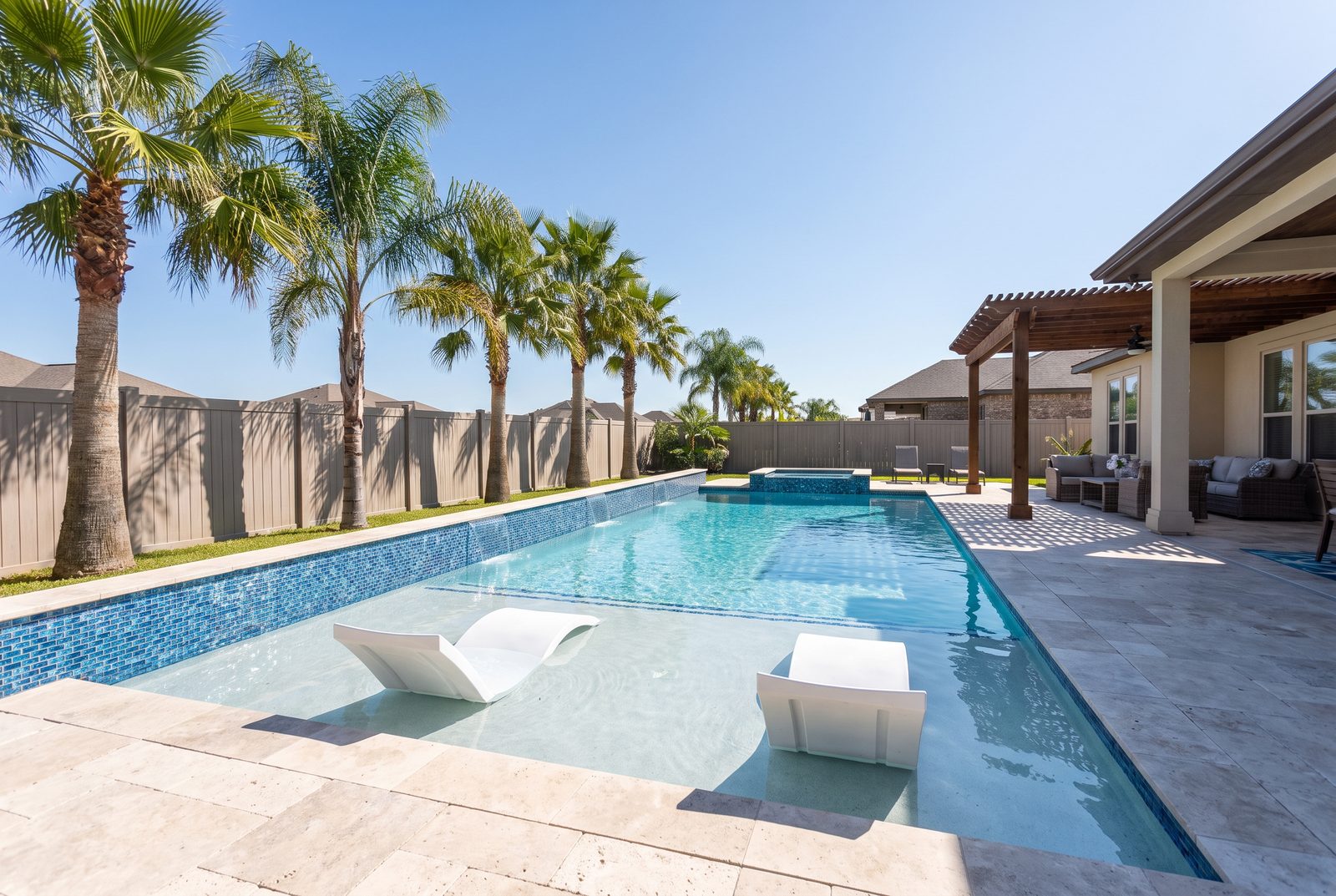
A pre-formed shell, a fast install, and less chemical upkeep — here's what fiberglass pool installation looks like in the Rio Grande Valley.
Fiberglass pool installation in McAllen starts with the same site visit and permit process as any pool build, but the construction itself moves faster. Instead of building a shell on site out of steel and sprayed concrete, a pre-manufactured fiberglass shell gets trucked in, lowered into an excavated hole, leveled, and backfilled.
That difference in method changes the whole shape of the project. There is no curing window, no plaster crew, and no multi-week sequence of trades waiting on each other. Most of the calendar goes to decking and finish work after you are already swimming.
Before anything is dug, the shell has to be ordered and a delivery route confirmed. This is the step that quietly decides whether the project is simple or complicated, because a shell up to 16 feet wide has to physically reach your backyard — either through a side yard gate, down a driveway, or lifted over the house by crane.
Excavation follows the shell's exact dimensions plus working room, with a compacted base graded dead level underneath. Fiberglass is unforgiving here in a way concrete is not: the shell takes the shape of what it sits on, so a base that is off by an inch shows up permanently in the waterline.
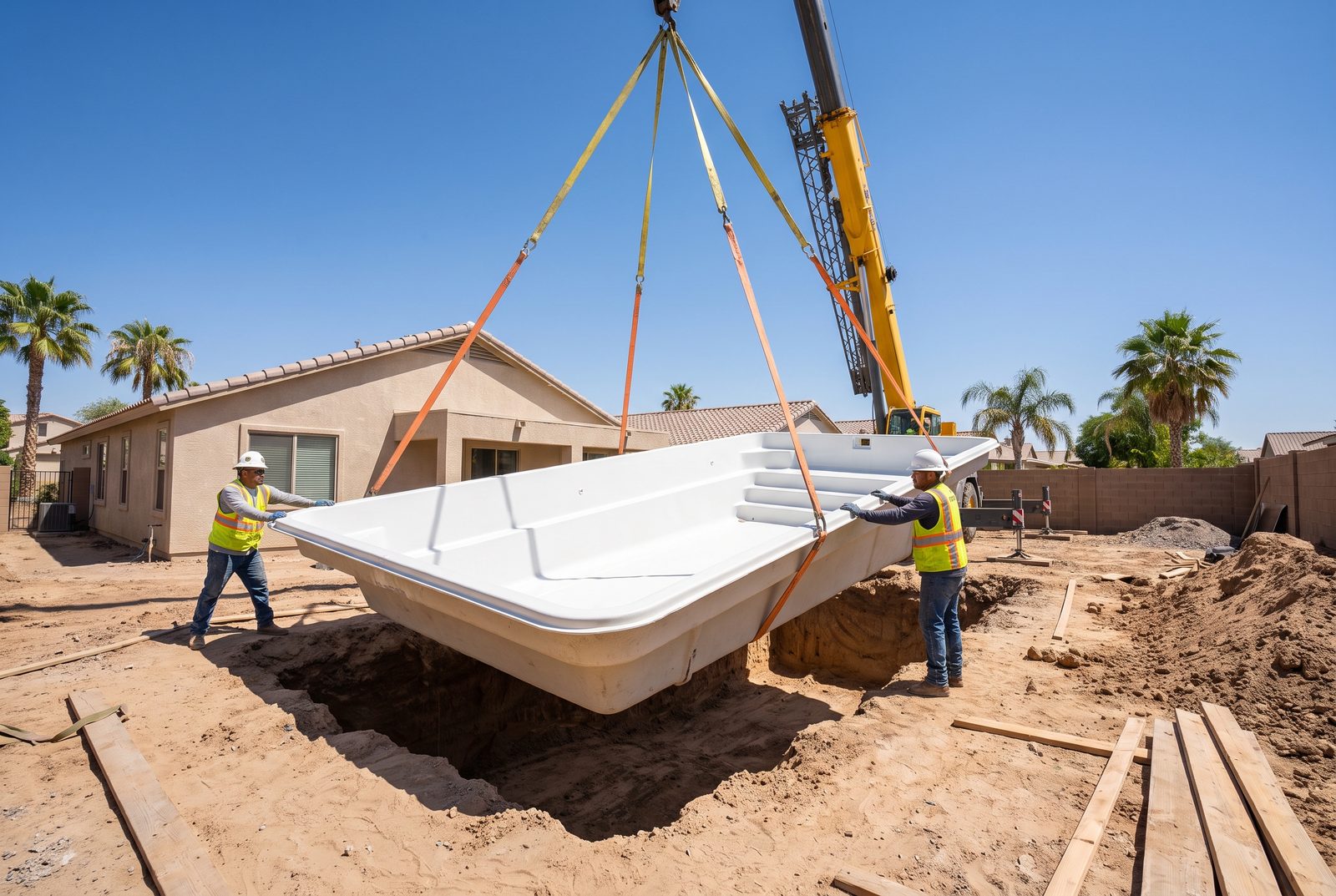
The shell is then set with a crane or excavator, checked for level in both directions, and plumbed. Backfill goes in around it in lifts while the pool is filled with water at the same rate, so the pressure pushing in from the soil and the pressure pushing out from the water stay balanced. Rushing that step is the most common cause of a fiberglass shell distorting.
From there it is coping, decking, electrical bonded to the requirements of Article 680 of the National Electrical Code, equipment set and started, and final inspection. Because there is no new plaster curing underwater, the startup period is far simpler than on a gunite pool — you balance the water and swim.
Two reasons, and the second one rarely gets mentioned. The first is texture: a gelcoat surface is non-porous and slick, so algae has almost nothing to anchor to compared to plaster, which stays microscopically rough no matter how well it was troweled. Less anchoring means less brushing and less chlorine spent killing what took hold.
The second reason is specific to McAllen. Tap water here runs about 14.5 grains per gallon, roughly 248 parts per million, which is classed as very hard and lands at about double the national average. When pool water drifts low on calcium hardness or pH, it goes looking for calcium and pulls it straight out of a plaster surface, which is what leaves that sandpaper texture on an older gunite pool. A fiberglass shell has no calcium to give up. Water can still deposit scale on it, and you still balance your chemistry, but the surface itself is not part of the reaction.
The practical result is a pool that ages more slowly in our water than a plastered one, and one that never goes through the chip-out-and-replaster cycle a gunite pool faces every decade or so.
Fiberglass pools in this market typically run $20,000 to $40,000 installed, roughly half of what a comparable custom gunite build costs. The variables are fewer than on a concrete pool, and that predictability is part of the appeal.
The single biggest line item. Shells run from around 10 by 20 up to about 16 by 40, and price scales with it.
A shell that fits through a side gate costs less to set than one that needs a crane staged out in the street.
Often the second largest number on the quote, ranging from broom concrete to travertine around the full perimeter.
Hard caliche still slows the dig, though a fiberglass hole is shallower and smaller than a gunite excavation.
Heaters, LED lighting, automation, and salt chlorine generators are all optional and priced separately.
McAllen has adopted the 2024 International Swimming Pool and Spa Code, and barrier requirements are part of the project.
Worth factoring into a fair comparison: a fiberglass pool has no resurfacing cycle. A gunite pool needs a new interior finish every 7 to 20 years, a recurring five-figure expense that never appears on a fiberglass pool's ledger.
Choose fiberglass when the standard shapes work. You get a swimmable pool in one to two weeks instead of six to ten, roughly half the upfront cost, a surface our hard water cannot etch, and no replastering bill ever. For most McAllen backyards with a rectangular or freeform footprint and reasonable access, this is the pragmatic answer.
Choose gunite pool construction in McAllen when geometry or access rules fiberglass out. If your lot is an odd shape, you want a specific depth profile or an integrated spa, you need a pool wider than 16 feet, or there is simply no way to get a shell into the backyard, gunite is not the more expensive option — it is the only option.
The honest tiebreaker: go stand in the backyard and trace the route a 16-foot-wide shell would have to travel. That five-minute walk settles the question faster than any spec sheet comparison, and it is the first thing we check at the estimate.
Most fiberglass installs are swimmable within one to two weeks of the excavation crew showing up, because the shell arrives finished and there is no concrete to cure. Decking and final landscaping can continue after you are already using the pool. The longest part of a fiberglass project is usually the wait for the shell to be built and scheduled onto a delivery truck, which happens before any work starts in your yard.
Around 16 feet wide by 40 feet long for most manufacturers, with a few models reaching 18 by 43. The limit is not manufacturing, it is the road: wide-load rules generally stop anything over 16 feet wide from traveling the highway, and every fiberglass shell has to be trucked from the factory to your driveway. If you want a pool wider than that, gunite is the only way to get it.
Yes. Fiberglass shells are built for continuous sun and heat exposure and commonly last 20 to 30 years, with well-installed shells going considerably longer. The gelcoat surface is the part that ages, and modern gelcoats hold color far better than the ones that gave fiberglass a bad reputation decades ago. Heat is not what shortens a fiberglass pool's life in McAllen; a poor backfill job is.
The gelcoat surface is non-porous, so algae has very little to grip compared to the microscopically rough surface of plaster. Just as importantly for McAllen, there is no calcium in a fiberglass shell for aggressive water to leach out, so the etching that turns plaster rough over time simply does not happen. You still balance the water, but the surface is not part of the chemistry the way plaster is.
The shell itself cannot be. You choose from a manufacturer's catalog of molded shapes, including models with built-in tanning ledges, benches, and steps, but the geometry is fixed once you pick one. Everything around the shell is fully customizable: decking material and layout, coping, lighting, water features, automation, and landscaping. Most of what people mean by a custom look lives in those elements anyway.
Not without a professional involved. A fiberglass shell relies on the water inside it to counteract the pressure of the soil and groundwater outside it, and an empty shell can bulge or lift out of the ground. This matters in the Rio Grande Valley, where caliche keeps water from draining downward and the ground around a pool stays saturated after heavy rain. If a repair genuinely requires draining, it needs to be planned rather than improvised.